Industries
WHO HAS SURPLUS WIRE IN UTAH
Surplus wire is not a single industry's problem. It accumulates anywhere electrical work is planned, purchased and then changed.
Why it accumulates
Wire is bought by the reel and used by the foot. A project that needs 4,200 feet of #12 THHN does not come with a 4,200 foot reel — it comes with a 2,500 foot reel and a 2,500 foot reel, and the remainder goes back to the shop. Multiply that across a year of jobs and a Utah contractor ends up with a yard full of material that is perfectly good and completely unmatched to the next project.
The same thing happens at a different scale in plants and utilities. Sparing requirements, minimum order quantities and cancelled capital projects all leave cable on a shelf. Nobody wants to scrap it, and nobody wants to inventory it forever.
That is the material we buy. We are not a scrap yard and we are not a distributor — we purchase surplus wire and cable, and we care about what the tag says.
Audiences
Businesses we buy from
Listed as the kinds of operations that typically hold surplus wire in Utah. Nothing here implies a relationship, endorsement or past transaction.
-
Electrical contractors
The most common source of surplus wire in Utah. Job closeouts leave partial reels, cut coils and cartons of MC cable that will never be matched to another job. We buy mixed lots from a single job or an entire yard clean-out.
-
Electrical distributors
Slow-moving stock, discontinued sizes, damaged-flange reels and special-order material that a customer never took. Distributor inventory is usually well labeled, which makes quoting straightforward.
-
Manufacturers and machine shops
Line changes, machine replacements and plant expansions leave tray cable, VFD cable, control cable and portable cord. Equipment lead and festoon cable often comes out with the machine.
-
Industrial facilities and processing plants
Food processing, mineral processing, cement and aggregate operations carry spares on shelves for years. When a plant re-instruments or replaces a line, that shelf becomes surplus.
-
Electric utilities and generation
Utility surplus is usually the highest-value material on any list: primary cable, service conductor and the shielded cable that ties a substation together. Reel tags and test reports are common and useful.
-
Data centers and technology campuses
Data hall fit-outs and refreshes produce tray cable, grounding conductor, VFD and cooling-equipment cable, and large quantities of low-voltage cable in unopened boxes.
-
Aerospace, defense and electronics manufacturing
Clean, well-documented surplus from controlled production environments. Material is often still in original packaging with labels and lot numbers intact.
-
Food processing and agriculture
Irrigation services, pump panels, dairy and produce operations, and processing plants all produce wet-location and direct-burial conductor as equipment is replaced or fields are reconfigured.
-
Commercial construction and property management
Tenant improvements, remodel cycles and building system upgrades leave coils of MC cable, boxes of data cable and partial reels of building wire in a mechanical room or storage cage.
-
Demolition, decommissioning and industrial relocation
When a plant is taken apart or a line is moved, the cable comes out in quantity. Some of it is reusable, some is not — we look at condition and tell you which is which rather than assuming.
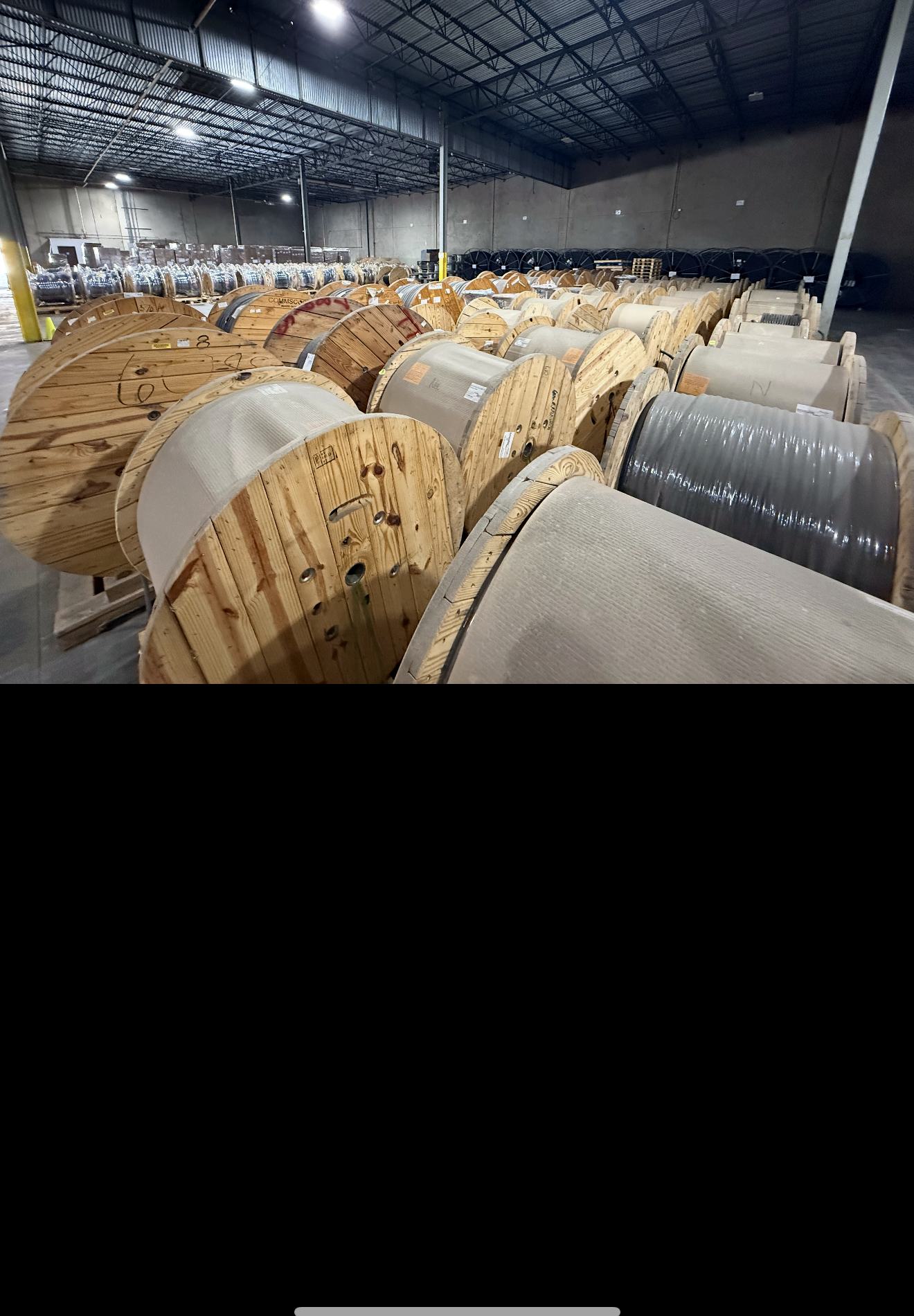
Warehouse inventory · reels tagged and ready to quote
Working with plants
Facility and utility surplus takes a little more care
At a plant or a utility yard, the questions are different from a contractor's shop. Material may be in a controlled storehouse, on a maintenance shelf, or still on a skid from a project that stopped. Access may require a badge, a safety orientation or an escort, and loading may need to happen inside a specific window.
Tell us those constraints up front. It is easier to schedule a pickup around a plant's gate hours than to discover them at the gate. The same goes for material that needs to be inspected before it moves — large primary cable, or anything stored outdoors for years, is worth looking at in place.
What helps most
- A list with size, type, approximate footage and reel count per line item
- Photos of reel tags, jacket print and the storage area
- Whether the material is in a storehouse, a yard or a trailer
- Site access requirements and the hours a truck can load
- Whether the material must leave by a specific date
Request a quote
Tell us what your operation has
One list, a few photos, and the city where the material sits. We will tell you what we can do with it and what a pickup would look like.